New Orleans, Louisiana, United States - October 13, 2028, 4:48 PM CDT
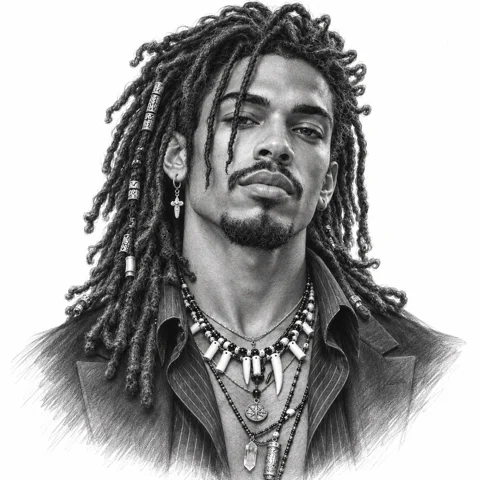
The three monitors were Jean-Marc DeBaptiste’s daily congregation.
They lit the wall of his office with the colors of his life: financial projections and market news on the left, live world headlines cycling in the center, his personal communications spread across the right — Signal, Telegram, the smaller apps his community had adopted one by one because someone’s niece had set it up for them. On the middle screen, a market in another hemisphere flickered; on the left, a chart climbed; on the right, an unbroken ribbon of messages in Creole, English, and the patois of a hundred different New Orleans practices scrolled past, and Jean-Marc sat before them in the quiet of his Garden District home with coffee going cold beside the keyboard, reading his congregation.
He swept a few thick locs away from his face, metal cuffs and beads shifting among the long strands. Jean-Marc was a lean, athletic Black man with pronounced cheekbones, heavy brows, and a strong jaw outlined by a meticulously trimmed beard and goatee. His black pinstriped shirt lay open at the chest, where chains and beads mingled with pale, tooth-shaped pieces. Rings caught the monitor light as he returned his hands to the keyboard.
The subject lines were mostly small. A client’s cousin had a new grandchild. A distant friend wanted a second opinion on a candle that wouldn’t stay lit. And toward the bottom of the Signal thread, a longer exchange — the voice notes longer than usual — from a friend whose mother was failing. The old woman’s kidneys were winding down; her heart was tired; the family had accepted it, and the family had, in the same breath, turned to him. When the time came — months, they guessed — they wanted Jean-Marc there. Not to fight it. To walk her across.
He typed a reply with two fingers, unhurried. Yes. He would come. They would talk to her in the weeks ahead; he would learn her stories, what she held to and what she held loose; he would teach the family what a good death sounded like, so they wouldn’t mistake it for distress. Preparing a soul for that crossing was careful work. It deserved the same rigor as an estate plan, and he gave it the same: dates discussed without flinching, duties assigned, the old woman’s own wishes mapped against the family’s hopes. He and the friend spoke of the arrangements in the shorthand of people who have done this before and will do it again, difficult and necessary in equal measure.
On Telegram, a different thread pulled him leftward. A friend — a deck-reader of real skill, whose accuracy had earned her the arrogance of certainty — had sent him photographs of a spread she didn’t like. Dark times, the cards said, in the way dark times say themselves: towers, floods, a moon reversed. Something is coming. I can feel it, JM. I’ve never had a spread sit this wrong on my table.
He read it twice. He believed her skill. He did not believe her conclusion — an ominous reading was a weather forecast, and weather was where forecasts went to be humiliated.
Jean-Marc practiced several forms of divination and trusted nearly none of them to mean what people wanted them to mean. His own instrument was a bag of sixteen cowrie shells, and he trusted it because it was poor at poetry. Each shell presented a binary — mouth open, mouth closed — and sixteen binaries gave him something no deck of seventy-eight images could: a count. Sixteen trials, a distribution, a probability he could write down and defend.
A card might mean a dozen things; a shell meant one of two, and the number of them that landed each way told him how loudly to listen. He knew — as any actuary knows — that a rare result was not a message. He also knew, better than most, that some rare results were worth every panic they cost. He trusted a count more readily than an interpretation. Certainty could still be misplaced; at least a count would tell him how much certainty he was misplacing.
His friend was not appeased by any of this. Her decks had earned her conviction, and her conviction needed feeding: You do one too, she wrote. Same question. Then tell me what you see.
He looked at the message for a long moment, thumb over the keyboard.
He could refuse — that would be the tidy thing. But her readings were good. Her instinct had been good before, and instinct that kept paying out deserved attention the way a client with a persistent hedge needed attention: not argued with, but priced. Partly to reassure her, partly to prove the point that her cards were weather and not verdict, he typed his answer.
Fine. I’ll cast on it tonight and call you after.
He went to his bedroom, took the satin bag from the top of the dresser, and loosened the drawstring. Sixteen cowrie shells tumbled into his palm, warm from the room, each one the color of dark honey with the little tooth of its mouth turned inward. For a moment he stood there, tempted to simply sit and cast now, on the bedroom floor, urgency being a poor excuse for a delay.
Then he checked the time: 4:55 PM
The reading could wait an hour. The suit could not — a tailored jacket was being held for him in the French Quarter, and the shop would want him gone before its close at 5:30. He returned the shells to their bag, left the bag on the dresser, and headed out on foot toward the Quarter, because a walk through the Garden District at golden hour was one of the city’s quiet payments for living there, and he was a man who tried to notice when life was paying him.
He was three blocks along Constance Street when the voices began.
They came from nowhere and everywhere, and they did not arrive the way spirit communication always had, in all his years of it: as an impression — a pressure, a weight of meaning that pressed against his understanding like a hand pressed to glass, which he then had to patiently decipher, word by word, hour by hour. This was nothing of the sort. These voices were audible. Plain as a neighbor beside his shoulder. Plain as the woman walking her dog ten feet behind him. His first instinct was that the living speakers were somewhere just out of sight — until the third voice joined, and the fourth, overlapping in a chorus that came from no direction and every direction at once, and Jean-Marc DeBaptiste stopped walking on a public sidewalk for the first time in his adult life.
More joined. Words collided; the chorus thickened into a wall of sound only he could hear, a frantic crowd pressing in. He couldn’t pull a single sentence from the tangle. He couldn’t even hold one voice long enough to follow it. He could only feel the shape of what they wanted — desperate, clawing, urgent — they wanted to be heard. They were trying to reach him through a wall that had never been there before.
He had never experienced anything like it.
And a thought arrived that he had spent his entire adult life not thinking, in the specific, prepared way one avoids a drawer one knows is full: perhaps the debt is being collected.
Before he was born, his parents had gone into the dark and bargained. Protection; a safer, better life out of Haiti. The price, agreed in advance, was strict rights to their firstborn child. Jean-Marc had lived thirty-two years beneath that claim — aware of it the way a man is aware of weather coming, someday, from a horizon he cannot see. He did not know when it would be exercised, or what collection would look like, and he had learned to live deliberately rather than constantly terrified. But he knew the account existed. Knew it the way he knew the mortgage existed. And a sudden chorus of the spirit world converging on him at once — a collection call if ever there was one—
His composure collapsed.
Heart hammering; sweat prickling along his hairline; a wave of heat, then a wave of cold. His breath went shallow and stopped entirely — he hadn’t told it to — and the edges of his vision began to darken, closing in like a curtain being drawn by a slow, patient hand. He stood frozen on the sidewalk, one hand catching a fence railing, thinking he might faint in full view of a neighbor’s gardenias.
Fear poured through him, faster than his discipline could channel it: his home. The life he had authored, deliberately, stubbornly, out from under the original terms. His parents — who had already lost the ability to give him the siblings they’d promised him, who would now lose him too, their only child, to a bargain struck before he could consent to anything. And beneath that, deeper, colder: what if death is only the delivery? What if what holds the claim intends to keep him? He had no way of knowing. He had lived his whole life in that no way of knowing, and in this moment, the uncertainty was worse than any answer could have been.
The voices stopped.
All of them. At once.
Not faded. Not one by one. Cut — like a circuit breaking. The chorus, the pressure, the wall of sound: gone, between one breath and the next.
Jean-Marc stood motionless on the sidewalk, listening.
He heard the street. A tram bell. A dog somewhere, mid-bark. The dog-walker’s footsteps continuing behind him, the neighbor’s sprinkler, all the mundane noise of a Friday at five. And beneath all of it — nothing. No whisper. No pressure. No faint impression of a presence at the edge of his awareness, the low-level hum of the spirit world he’d lived beside so long he’d stopped hearing it, the way a man stops hearing his own refrigerator.
The universe had disconnected the call.
For one disoriented moment, he wondered — calmly, terribly — whether he had died. Whether this was the other side, and the silence was simply the sound of arriving. His hand rose to his own neck, fingers pressing beneath his jaw. Beneath them, his pulse pounded, hard and fast, alive and frightened. He breathed. Again. He was still here.
He waited for the familiar presence to return. The hum. The pressure. Anything. He strained the way one strains for a word on the tip of the tongue, listening harder than he had ever listened, into a silence that did not thin because he asked it to.
The absence was complete.
As his breathing steadied, he made himself reason, because reasoning was the rope in this well. Spirits lingered — that was the ordinary texture of his work. Days, weeks sometimes, while he worked out what they wanted, while negotiations unfolded at the pace of careful correspondence. Communication was slow, uncertain, frequently frustrating. It had never erupted like that — a riot of the dead demanding his ear — and it had never ended so absolutely, so administratively, as if a switch had been thrown in some office he had no address for.
His panic eased. His unease did not.
Something had been trying to reach him. Several something, urgent. Now he could not feel a single one — not them, not the ordinary hum, not the faintest ghost of a ghost. He didn’t know if they had been warning him about the debt, or about something else entirely, or simply begging a worker in the trade for help. He knew only that something had changed, in the world or in him, and that neither possibility comforted him at all.
The tailor could keep the suit.
Jean-Marc turned for home with a speed that raised no curiosity on a Garden District sidewalk, because a man walking fast in the Garden District was merely a man getting his steps in. He needed the shells. He had never once been able to read his own fortune — the one exception, in every tradition he knew of, that kept diviners honest — but perhaps a broader casting would tell him something about the disturbance. About the silence. He let himself in, moved through the house to the small table in his bedroom that served for readings, and lit a single candle with hands that were almost steady.
Then he did the hardest thing in his repertoire: he sat still and listened.
For a long minute, he gave the room his full attention. Nothing had followed him home. No spirit pressed at the edge of his awareness. Not the hum, not a whisper, not even the polite sense of someone about that he usually carried like background radiation. The room had never felt so empty. In thirty-two years, he could not remember that — a room where the dead had never been, rather than a room where they were simply quiet.
He opened the satin bag and poured the sixteen shells into his palm.
Part of him — the actuary, the part that priced panic for a living — observed that fear was making him foolish, that readings cast in terror told you more about the terror than the future. A larger part of him was afraid of what the shells might say. He weighed the two, as he weighed everything, and proceeded.
He held the shells in his fist. Blew across them, once, the breath carrying the question the way his grandmother’s had — is the way open, and if not, what has closed it? — and cast them onto the table.
They scattered, rattled, settled.
Jean-Marc looked at the result for a long, still moment.
All sixteen lay closed.
His breath caught. He studied each shell in turn — tipping one with a fingertip to be sure, counting, recounting, walking the table’s surface like an auditor looking for the single open mouth that would break the result and return the world to sense. There was none. Sixteen closed mouths stared up at him from the candlelight like sixteen shut doors.
One in sixty-five thousand five hundred thirty-six, said the actuary, before the man could stop it. Each shell an even coin: open or closed. Sixteen heads in a row. A probability small enough to fit in a word: unlikely. Possible — any single cast could produce it. But sitting alongside a chorus of audible spirits and an absolute, circuit-breaking silence, the number stopped being a curiosity and became a datum.
And within his practice, the meaning of the cast was not a matter of interpretation at all. An entirely closed cast signified one thing: blockage. No passage. No answer. No access. He associated it with darkness and destruction — with the spirit world closed against the person seeking contact, every road shut at once. The shells were not predicting a future.
They were confirming a present.
He gathered them immediately, every shell, back into his fist, and carried them into the kitchen. From the refrigerator, purified water; he poured it over the shells in a thin stream, cleansing them of the question, brisk and deliberate, though his hands had not quite steadied and a single shell skittered against the sink’s steel with a sound like a tooth. He set them to dry on a clean cloth. Then he took sage from the pantry, lit it, and walked the house room by room, fanning the smoke into corners, along baseboards, across thresholds, watching the smoke for any change — a curl against current, a sudden taste of presence, anything that said the cleansing was doing anything at all. The silence persisted, total, untroubled by his smoke.
He stood in his own hallway, smoke thinning, and considered escalation. An offering — to whom? A sacrifice — for what? He could not tell whether he had offended some entity, whether this was a warning aimed at him alone, or whether he had witnessed something far beyond his household’s business. He was frightened enough to consider drastic measures. He was disciplined enough to know he did not yet know what he would be answering. A payment made to the wrong party for the wrong offense was worse than no payment. He had watched desperation spend everything on the wrong door.
He started a bath instead — leaves and herbs steeping in the hot water, a ritual cleansing of the self, of whatever residue a cast like that left on the caster. While the tub filled, he returned to his office and opened the messaging windows.
Four messages, four trusted leaders across his spiritual community — different religions, different practices, different corners of the city’s enormous quiet congregation. He kept each message short and factual, because facts traveled fastest. An abrupt disturbance in spirit contact late this afternoon — an eruption, then complete silence since. Have you experienced the same? I need to know how far this reaches.
He watched the conversations for a few moments. No replies. Of course — Friday evening; people at dinner, at work, at worship. The people he’d messaged needed time to see the messages and answer, and staring at the screen would not accelerate their eyes.
He made himself step away. He returned to the bathroom, undressing as he went, and lowered himself into the water.
The herbs steamed around him. The bath did what baths did — loosened the shoulders he’d been carrying at his ears since Constance Street — but it could not loosen the number. It kept returning, patient as arithmetic: one in 65,536. He knew — better than the woman who’d demanded the reading — that an unlikely result can occur without meaning anything, that somebody, somewhere, casts sixteen closed shells every few years and draws no conclusion from it. But sixteen closed shells, after that chorus and that silence, in a world where he could not feel a single spirit in his own home…
He waited in the water. Listening for the dead.
And for a notification from his computer.
He could not sit still in the silence, and he did not try to.
Jean-Marc dressed, left the house, and walked — quickly, deliberately — toward the French Quarter. Not the tailor’s; past it. He needed a person, not a cast: Hoodoo That Voodoo, the voodoo supply store on the edge of the Quarter his old friend had kept for decades, where the shelves held incense and the back room held sense. A conversation. Two practitioners reasoning together over candles and coffee could occasionally accomplish what sixteen shells could not.
He was well along Constance, the Garden District’s fences giving way to busier blocks, when the sound reached him.
A crash — tremendous, the kind of sound the mind first files as explosion, metal and violence at once, tearing through the ordinary street noise of traffic and conversation ahead. A car alarm began somewhere. Then screaming.
Jean-Marc rounded the corner onto Canal and saw the bus.
A public bus lay on its side beside a semi tractor that had been crumpled nearly in half. Glass everywhere, glinting. The bus’s flank faced the sky, its roof line crumpled, and from inside it came the screaming — human voices, many, alive, and Jean-Marc was moving before the thought completed, because the living came first, always, that was not even a principle, it was a reflex.
The semi was closer. He reached it first, hauled himself up to the shattered cab window. The driver sat crooked in the ruined seat, mangled, motionless. Jean-Marc reached in, checked for breathing — none — found the man’s wrist, pressed two fingers in, held them there through three of his own heartbeats. No pulse. The man was gone. Jean-Marc closed his eyes for half a second, gave the stranger the acknowledgement one human owes another, and turned — because the bus was screaming.
He climbed the exposed underside of the tilted bus, using the axles and the wheel wells for footholds, and pulled himself onto the upward-facing side of the wreck. The window nearest him was already cracked and webbed from the impact; he put his elbow through it and lowered himself inside, into a darkness full of dust and diesel and screaming.
He came in near the worst of the damage. And the first thing the light showed him was the dead.
Six of them, unmistakably dead — bodies ruined in ways the mind registers before the eyes finish reporting: angles no spine takes, blood where no blood should be, stillness of a quality that no living body at rest ever achieves. Jean-Marc stood among them, braced on the tilted ceiling-luggage rack, and for a moment he could not reconcile what he was seeing with what he was hearing.
Because the screams were coming from them.
The bodies lay ruined around him, and the voices rose from their places — distinct, individual, audible, each one a person, each one in absolute, animal panic — panicking inside flesh that could no longer sustain them. They were screaming to be let out. They were screaming that they could not move, could not breathe, could not understand. One voice, a woman’s, close to his left, was repeating I can’t get out, I can’t get out, I can’t get out— in a rising, gasping loop. A man’s voice near the front was not words at all, just the sound a person makes when they know.
Not impressions. Not the slow, patient pressure of meaning-through-glass. Distinct voices, the same as the chorus on Constance Street — and he understood, now, who the chorus had been, or at least what kind of thing it had been: people in this exact state, trying to reach anyone who could hear.
They were trapped.
Jean-Marc had helped countless people through the approach to death. It was his deepest work, the work his parents had unknowingly paid for with their son’s future: the bedside, the long patience, the crossing itself. And in all of it, one rule had held without exception — at death, the spirit departs. Instantly, naturally, beyond his craft entirely; not even the most powerful practitioner he knew could stop it, let alone want to. Even the dead who returned to haunt a place — the angry, the unfinished, the bound — even they first passed beyond his perception, through the door, before something brought them back. The door opened. Everyone went through.
These spirits had not gone anywhere.
Something had prevented their departure. The bodies were dead — he could see it, could smell it, the coppery truth underneath the diesel — yet the people remained, tethered to the ruined flesh, conscious, panicking, unable to leave. Jean-Marc DeBaptiste, who had built a life on the assumption that the door between worlds was always open, stood in a wrecked bus among six people for whom the door had closed, and felt something he had never felt in his practice: that he was looking at an abomination. Not a tragedy — he knew tragedy, worked in tragedy, honored it. A break in the cycle itself.
Their panic made him sick. It climbed into his throat and sat there. Emergency vehicles were arriving outside now — he could hear sirens winding down, engines, shouts, the pop of a fire line starting — and he made himself turn away from the dead and toward the living, farther back in the tilted bus, because whatever was happening to the dead, there were people here he could still help.
He checked them one by one. A teenager with a bleeding scalp, guided to press, keep pressure, talk to me. A man with a wrist bent wrong, told him not to move it, told him his name, made him say it back. An older woman, bruised, shaken, who gripped his hand and would not let go until he’d told her twice that she was going to be all right. Many were bruised; some were bleeding; all were alive and responsive and terrified, and he moved among them being calm with them, deliberately, manufactured calm, the most useful forgery he knew.
Emergency responders reached the interior — flashlights cutting through the dust, a firefighter’s voice calling for the walking injured — and Jean-Marc followed their directions, steadying, passing supplies, pointing out injuries, extricating with them, while around and beneath and through it all the voices of the dead continued, looping, pleading, not one of them stopping.
When the last living survivor was out, a firefighter helped Jean-Marc climb out through the broken window and lowered him to the street.
Outside: the news van already arriving, crews working the wreckage, the cordon, the lights. Jean-Marc stood off to the side for several uncomfortable minutes — dirty, blood-smeared at the sleeve, a man in fine clothes who looked like he belonged to the story — waiting for someone to notice him enough to ask.
Then the attention shifted — a gurney, a shout, the cameras swinging elsewhere — and he slipped away between the vehicles, without giving a formal account, without giving his name. He had no desire to appear on the evening news, and none whatsoever to explain, to a reporter or a police officer, what he had heard inside.
He walked, and as he walked, the evening rearranged itself around the new evidence.
This could not be his parents’ debt. Six strangers had been prevented from leaving their dead bodies — six people with no share in a bargain made in Haiti before his birth. Whatever had happened this evening reached far beyond Jean-Marc DeBaptiste, and the relief of that was thin and cold, because the alternative was so much larger.
He began — carefully, provisionally, the way he held every conclusion until it was corroborated — to suspect the shape of it. The silence on Constance Street: spirits already beyond the boundary could no longer reach him. The closed shells: no passage, no access, the cast reading blocked in every door at once. The bus: the newly dead could not cross the boundary either. Two symptoms, one cause.
The spirit world has been cut off from the mundane world.
He turned it over as he walked, testing the joint of it. If the boundary had been sealed — if something had shut the passage — then everything he had experienced this evening followed without contradiction. And the next question walked in uninvited, because it was the question his whole life was built to ask: what would that cost? He had never heard of anyone possessing the power to halt that passage — no tradition he knew claimed it, no story he’d been raised on credited anyone with it. Magick at that scale was not a working; it was a geological event. And if someone had done it — what could the price possibly be? What is given, received, moved, or changed, when what is moved is the boundary between the living and the dead?
And beneath the cost, the balance itself. Death was not an event, it was a movement — part of a cycle, out one gate and in another. If the out-gate had been obstructed, what happened to the in-gate? Flow was flow. You could not dam a river at one bank and expect the current to notice the difference.
A new question took hold of him, quietly, on a sidewalk full of sirens, and would not put him down:
If the dead cannot leave — can new life still enter?
The nearest hospital stood a long ten blocks away, and Jean-Marc walked it fast, past the cordon, past the news vans, past a knot of bystanders filming one another in front of the wreckage.
If something had obstructed death, he needed to know whether birth had been affected as well. The question had entered him on the sidewalk and would not leave, and there was exactly one place in the world to test it.
He entered through the emergency department. The department was busy — doctors and nurses moving briskly, gurneys parked in the hall, the particular pitched urgency of a trauma night — but busy in the way hospitals were busy, not overwhelmed. A night with a bus crash in it, not a night collapsing.
He kept moving into the interior, took out his phone, and dialed Joanna.
Joanna was an RN he knew from years back — the debt was small, human, and old, the kind that exists between people who have helped each other and never once counted. She answered on the fourth ring. Yes, she was working tonight. He reminded her of the favor — from years earlier; a thing she’d needed, a thing he’d done, a ledger neither of them had opened since. She remembered. She remembered exactly, and said so, and there was a smile in it that faded when he explained what he needed: a few minutes of her time, and access to the maternity wing.
She agreed to meet him outside the unit.
Jean-Marc took the elevator to the second floor. Joanna was waiting at the locked entrance to maternity — scrubs, badge, hair pulled back, a woman he remembered as unshakeable now standing with her arms crossed and her weight on both feet like someone expecting the floor to move.
“Okay,” she said, without hello. “What is going on?”
“Something feels wrong.” He held up a hand, owning it. “I can’t explain it yet. I’m not going to pretend I can. But I need to ask you a specific question, and I need you to answer it exactly.” He met her eyes. “Have there been any unusual problems with labor or delivery this evening?”
Joanna did not answer immediately. She looked at him — a long, level look, the look of a nurse deciding how much of the truth a visitor can carry — and then she said, quietly, so the hallway couldn’t hear:
“We haven’t had a single live birth since earlier this evening.”
The women were there. The labors were there. The deliveries they had all been expecting — the ones with dates, with charts, with fetal monitors reading healthy at four o’clock — had simply not happened. Two mothers remained in active labor right now, and their progress — or the absence of it — was troubling the attending staff badly. One had been laboring since approximately 5:15 that evening. It was now around ten. Five hours of active labor, full-term, with every intervention they were permitted to try, and no progression. Nothing had moved since quarter past five.
“And there’s a third mother,” Joanna said, and now her voice did the thing voices do when they carry something heavy and are trying not to spill it. “Planned C-section — her history made it a planned section, previous C-section, the whole thing was routine, it was on the schedule.” She stopped. Started again. “The baby was delivered. It was stillborn.”
Jean-Marc fell quiet.
He had come looking for evidence of an obstruction. A pattern, a trend, a number to place beside the closed shells. Somewhere inside this unit, behind the door Joanna was guarding, a mother lay in a recovery room having lost her child — and Jean-Marc’s abstract question about in-gates and out-gates had just acquired a face, a room number, and a family.
He stood with it for a moment. He let it have its weight.
Joanna was watching him, and her unease had changed quality — from the professional wariness of a nurse with a strange visitor to something more personal. “Jean-Marc,” she said. “Your questions are too specific. And your face. What do you know?”
“I don’t know enough yet.” He said it simply, because it was the truth, and she deserved truth over comfort. “I’m trying to determine whether what I’ve witnessed elsewhere connects to what’s happening here. If I learn something that could help you, or your patients — I promise, you’ll hear it from me.”
He could see her decide whether to believe him. She had known him a long time; the ledger helped; trust, once earned, compounds.
“Then what do you need?” she said.
“I’m calling in my favor.” He said it without flinching, because disguising it would have insulted them both. “I need you to contact me if anything else unusual happens during your shift. Especially two things: whether any babies are born alive. And whether the stalled labors begin progressing.” He held her eyes. “And I need you to call me when your shift ends. A thorough account — what changed, what didn’t, and when. As close to the clock as you can manage.”
Joanna agreed, held his gaze a moment longer — the look of a woman filing away the fact that tonight had a shape, and the shape had a name — and then turned and went back to her patients.
Jean-Marc rode the elevator down alone and ordered an Uber from the ER’s automatic doors.
The trapped spirits and the reports from maternity sat side by side in his mind now, and they were the same fact wearing two masks. Both ends of the cycle — obstructed. The dead could not leave; the living could not enter. He needed to understand how, and he stared out the car window at the city lights sliding past and did what his mind did with all incomprehensible mechanisms: he built a model.
He began to think of the obstruction as a lock.
Something had locked the passage between the worlds — locked it at both ends, in-gate and out-gate, with a completeness that even the natural pressure of a whole city’s dying could not force. And a lock, unlike a wound, unlike a curse, unlike a haunting, implied a maker. A lock was an artifact. It had a mechanism.
He wanted to examine the mechanism.
And he wanted to determine what kind of key could possibly open it.
The Uber let him at his gate a little after eleven, and Jean-Marc went past the bedroom, past the office, to the living-room wall of books.
He had spent years collecting the wall — old tomes on occult and esoteric knowledge, some of them expensive, some of them ugly, a few of them the kind of thing you bought from an estate sale with a receipt that said misc. lot and never asked too loudly where the lot had come from. Tonight he began with the oldest volumes, because whatever had locked the boundary was not young.
He searched the shelves by touch and title and pulled five books — three clothbound, one missing its spine, one so water-swollen it opened itself — carried them into the small dining room, and laid them on the table. Then he went to his office to check his messages before beginning, because somewhere in the last four hours, the world owed him answers, and three of them had arrived.
Three replies waited on the communications monitor. He opened the first, from Abeni.
Abeni practiced Santería and was known, in their community, for her ability to communicate with spirits — a talent Jean-Marc respected and, privately, considered finer than his own. Her message was short and wrong in every particular.
Around five o’clock, she had become disoriented. An overwhelming flood of sensation — like every voice I ever heard all talking at once — and then a terrible migraine that had put her in the dark of her own bedroom with the phone at minimum brightness. And since then: nothing. She had tried to reach the spirits — repeatedly, JM, the way I have done it my whole life — and nothing answered. Nothing there. She had never in her life had to reach before; they were simply there.
Jean-Marc read the time she gave — just before five o’clock — and read it again.
The second message came from Dominique — a young Creole man, new to the practice of Louisiana Voodoo, who sought Jean-Marc’s advice often, because Jean-Marc’s knowledge ran across several traditions and Dominique’s ran deep into exactly one of them.
Dominique’s account came out in a tumble: an angry spirit had attacked him earlier that evening. It began wailing — a sound that had frightened him badly enough that he’d fled his own front room — and then, almost immediately, it had vanished. He was writing because he was desperate; he feared it would come back, and that next time it would hurt him.
Jean-Marc paused over the message, one finger resting on the desk.
Dominique had never previously claimed to communicate with spirits. Not once, in all the times he’d come with questions and candles and problems — he had always been emphatic that the hearing was not his gift, that he was a man of hands and herbs and fire. Perhaps an ability had surfaced for the first time tonight, violently, in the middle of whatever had erupted. Perhaps he had experienced something else entirely. Jean-Marc needed more detail before he decided what the young man had heard — or how to advise him, or how worried to be on his behalf.
The third message was from Jessica Hartley, his contact at the Orleans Parish coroner’s office, and it was the longest, and it was the one he read three times.
A recently deceased man’s body had disappeared from the morgue.
She asked — carefully, formally, as though writing it made it worse — whether Jean-Marc knew of any practitioner or local group that might seek a human corpse. Because the security footage had not revealed an obvious theft; the police had reviewed the recordings and found nothing relevant to the case, according to them, and would not acknowledge the obvious; and her suspicion, which she had not shared with the police, was this:
A man passing an exterior camera in the alley looked almost identical to the missing deceased.
She was afraid of how the suspicion would sound — she said so twice — and she told him anyway, because she trusted him: she was ninety percent certain that the man walking outside the building was the same man who had been dead on a table approximately an hour earlier.
There was also a broken basement window in the room where the body was held. The opening was small — barely large enough for someone to squeeze through. And according to her account, the police believed the window had been broken from inside the building: the glass had been scattered outward, onto the street side, suggesting that whoever passed through had been leaving.
The police working theory was a theft, or a grotesque prank. Jessica’s feeling, which she could not shake, was that something more sinister had happened. She asked Jean-Marc to call if he knew anything that could explain it.
Jean-Marc read all three messages again. Then once more.
Abeni’s experience resembled his own — eruption, then silence, the same clock. Dominique may have heard the same sudden eruption of spirit activity, through a door he hadn’t known he had. But the missing corpse presented a different problem entirely, and it did not want to fit the shape of the evening, and Jean-Marc was too honest a bookkeeper to force it.
At the bus crash, he had heard spirits trapped inside bodies that could no longer sustain life. Now Jessica Hartley — someone he trusted, someone whose judgment he had never once had reason to doubt — believed she had seen a dead man walking. He could not yet determine how those observations fit together. A man who couldn’t leave his body, and a man who had apparently left with it.
He returned to the dining table, telling himself the truth he could bear: he would answer once he had a better understanding of what was happening. He was not ignoring his community. He was not ready.
Five old books waited before him. He opened the first without knowing which passage, term, or precedent he should even be looking for.
He began searching anyway. Somewhere in these pages, he hoped to find a clue to something his experience told him should be impossible.
Jean-Marc woke to his cell phone ringing.
He had fallen asleep at the dining table — hours earlier, cheek on forearms, the five books open around him in a half-moon of failed research and one candle burned down to a stub — and for a moment he surfaced without knowing which world he was in. Then the phone, ringing on the table beside his face.
Nine o’clock. The next morning.
He straightened in the chair, cleared his throat, and answered. “Joanna.”
Her voice was flat with a fatigue that had gone past tired into something else. “You said to call.”
“I did. I’m here. Tell me.”
“There have still been no live births.” No hello. No preamble. “The two women who were in active labor when you visited are still in active labor. Undelivered. Overnight.”
Jean-Marc sat up slowly.
“Two more women arrived in labor overnight.” Joanna’s voice was careful now, precise, the voice of a nurse building a report she did not want to be making. “Neither has been able to complete delivery. It’s not one difficult labor. It’s not one bad night. It’s everyone, JM. Every labor that starts, stops.”
She hesitated then — he heard it, the little intake of breath of a woman about to say the thing she’d been told in confidence and couldn’t hold alone.
“And I’ve heard — this is not for broadcast — from at least two other hospitals in the city. Same problem. No live births since yesterday afternoon. None.”
Jean-Marc absorbed this in silence, and then said the second thing, because he had meant to say it first and because she had earned it: “Thank you, Joanna. Your debt to me is settled. You’ve provided exactly what I asked for.” A pause. “You may find that fair, or you may find it too small for what you gave me tonight. It is not too small to me.”
Her breath came out, something between a laugh and nothing. “You’re a strange man, Jean-Marc.” A beat. “Be careful. Whatever this is — be careful.” And she rang off, because somewhere behind her a monitor was alarming, and that was a world he did not belong in.
He ended the call and sat for a moment, absorbing it. No live births. The whole city. All night.
He went to his office and checked the news monitor, and a headline caught him the way a fishhook catches: ROMANIA CLOSES BORDER AMID REPORTS OF HIGHLY CONTAGIOUS ILLNESS WITH HIGH MORTALITY RATE.
He read it twice, and then made himself read it a third time, because the thought underneath it was enormous and he wanted to be sure it was the headline lifting it, and not his own fear. Could this be connected? An illness with a high mortality rate, on the same morning no child in New Orleans could be born. The thought would extend the disturbance far beyond New Orleans — beyond the Gulf, beyond the hemisphere — into a scale he had not yet permitted himself to consider.
He set it aside. A single report about an illness was not enough to establish a connection; a man who chased every headline would be chasing weather. He already had something closer to home that he could investigate directly — and directly was the only scale on which he could trust himself right now.
He called Jessica Hartley at the coroner’s office and asked whether she could meet him for lunch.
Jessica agreed, but warned him her schedule was tight — the missing body had brought paperwork down on the office like a verdict, and she was short-staffed and short-tempered. Jean-Marc offered to bring lunch to her, at the office. That arrangement suited her. It suited him, too, for a reason he did not say: the visit would put him near the bodies being held there. He needed to know whether other corpses contained the same trapped, distressed spirits he had heard inside the bus — whether the crash had been an isolated catastrophe or a condition, and whether the dead of an ordinary day were lying in refrigerated drawers, screaming into stainless steel, unheard.
He still did not know whether the crash had revealed an isolated event or a wider state of the world. Hearing the dead elsewhere would give him another piece of evidence — and make the implications harder to escape.
He walked slowly to his bedroom to dress, moving like a man reserving his strength, and stood a moment before the mirror, fastening the layered necklaces, settling the jacket, arming himself in the outward assurance the day would require. He had a reason to enter the coroner’s office.
Now he needed to prepare himself for what he might find there.
Jean-Marc arrived at the Orleans Parish coroner’s office at two o’clock, carrying lunch from a lavish Uptown restaurant — the kind of lunch that arrives in three bags with the restaurant’s name embossed on the paper.
He told the receptionist he was there to visit Ms. Hartley, and sat down at her request, on a bench beneath a certificate of accreditation, among strangers waiting for news of the dead with the particular stillness of people preparing to identify someone.
Jessica Hartley came out to greet him a few moments later. She thanked him for lunch — warmly, and then with the small laugh of a woman embarrassed by the scale of it: “You did not have to bring something this expensive, JM.”
“You contacted me,” Jean-Marc said. “And you trusted me with what you witnessed. That is not a small thing you did.” He handed her the bags. “Bringing you a good meal is my way of returning that consideration. There is no more to it than that.”
She looked at him a moment — the look of someone deciding whether to accept a gift at its stated value — and accepted it.
Jessica escorted him farther into the building, and with her badge and her manner preceding him, no one questioned his presence. They settled into the break room, ate, and caught up — the office gossip, the missing-body case that had everyone rattled, the ordinary small currency of a friendship maintained across years. Jessica ate the meal with the appreciation of someone who had been surviving on vending machines.
Afterward, she took him down to the basement to show him where the body had disappeared from. They walked the corridor toward the room where the deceased were held, and Jean-Marc heard the voices before Jessica touched the door.
Several of them — muffled, as though through a wall or a pillow, and screaming for help.
He glanced at Jessica. She was fumbling for her badge; her face showed nothing but the mild dread of a workplace tour. She heard nothing. She gave no indication that she heard anything at all.
Jessica opened the door.
Inside, the room was white light and stainless steel — and the source of the voices was unmistakable now, terrible in its specificity. Individual refrigerated compartments were built into the walls, drawer by drawer, bodies inside them awaiting examination or release, and some of the people tethered to those bodies were crying out. Not all of them. He could hear the silence of most of the drawers — the ordinary dead, gone where the dead go. But from four of the compartments, distinct and individual, the voices came: please — please, somebody — I’m in here — I’m in here, I can’t—
Jean-Marc kept his face still. It took more than it ever had.
Jessica showed him the broken basement window — small, low, glass still glittering on the outside sill — and the empty steel table where the missing man had lain awaiting autopsy. She narrated the timeline while Jean-Marc stood with his hands clasped behind him, listening, struggling with everything he had to keep his attention on her explanation while the screams continued only feet away, one of them — a woman’s voice — repeating the same phrase over and over with the tireless patience of the trapped.
Jessica took out her phone and played him a recording of the security footage. The alley, in grainy gray: a man walking through frame, unhurried, clothed, alive in every particular the camera could record.
The camera did not show the window itself. There was no recording of anyone climbing through it. But Jessica remained convinced, and said so again, quietly: the man in the alley was the deceased. The man who had been dead on that table. She’d processed his paperwork; she’d looked at his face on the intake form not two hours before the recording.
Jean-Marc approached the refrigerated compartments — slowly, his attention split, his skin crawling — and asked Jessica about each drawer from which he could hear a voice. He indicated four in particular, trying to look like a man making conversation about layout and capacity rather than a man taking testimony from stainless steel.
“All four of those came in within the last day,” Jessica said. “People who died within the preceding twenty-four hours.” She frowned slightly, checking her own memory. “Why those four?”
“Timing,” Jean-Marc said. “Can you tell me more precisely when each of them died?”
They established it together — Jessica pulling the intake log, reading the times aloud while Jean-Marc stood very still, and the pattern assembled itself in the air between them as she spoke. All four had died after five o’clock the previous afternoon.
After five. The same hour his spirit contact had erupted into that frantic, audible chorus — and then vanished. The same hour Abeni had been floored. The same hour Dominique’s unseen spirit had wailed and fled. Everything that had died after the door closed — stayed.
For Jean-Marc, the evidence now supported one terrible conclusion, and it no longer required his permission to be believed. The spirits at the crash were not an isolated occurrence. Newly dead people remained trapped in their bodies — in wrecks, in hospital beds, in stainless steel drawers, screaming silently into rooms full of the living who could not hear them. And the hospitals reported that no new life had entered the world. None, in the entire city, since the previous afternoon.
No life in. No life out.
Something had obstructed passage at both ends of the cycle — sealed the out-gate and the in-gate with the same stroke, and the stroke had fallen at five o’clock, and everything on either side of it was now stuck.
He closed the intake log gently and handed it back.
“Jessica.” He made his voice the careful one. “I want you to hear me on this. If you believe the missing man walked out of here — and I am not going to tell you that you’re wrong — then take the next couple of days off. I mean it. If another body rises and attempts to leave, you should not have to be standing in this room when it happens.”
Jessica looked at him for a long moment, the look of a woman weighing whether the thing she’d seen was as impossible as it felt, and whether the man in front of her was the only person alive who might believe her.
“Take the days,” Jean-Marc said again, gently. “Please.”
He left the coroner’s office into the gray afternoon determined to seek other opinions — his own conclusions, however well-evidenced, were still his alone, and a structure this terrible needed more than one foundation. He would begin with the practitioners and contacts he knew in the city, then reach farther afield. Abeni first. Dominique, with questions. The wider network after them, outward in circles, like a stone dropped in a pond.
And he intended to keep searching — through the books, through the community, through every tradition that had ever written anything down about the door between worlds — until he understood what could have done this.
And what was exchanged for it.
Because power on this scale did not exist without a price. He had built his whole life on that understanding — that everything moved by exchange, that something was always given, received, moved, or changed. A working that stalled death for an entire world would have cost. Somewhere, in some record, in some memory, in some tradition’s oldest and most guarded account, there must exist an itemization of what it cost to stall death.
He intended to find the invoice.
Back home, Jean-Marc sat at his computer and wrote the account out in full.
He wrote it the way he built all his documents: precisely, in the order things had happened, with what he knew separated from what he believed. His conclusion went first, stated plainly, and he made himself state it plainly because his correspondents deserved his actual position, hedged as it was: passage to the spirit world appears to be blocked. And the reported absence of live births in New Orleans began at approximately the same time that spirit communication fell silent.
Then he reached across the spiritual communities he had come to know over a lifetime of careful belonging: Vodou leaders whose trust his family’s name had helped build across two generations; Ifá babalawo whose divination systems ran on the same binary logic as his own beloved shells; Santería practitioners, Abeni foremost among them; Hoodoo practitioners working the old crossroads knowledge; and the members of a local pagan coven he’d exchanged favors with for a decade. He needed perspectives beyond his own — beyond his tradition, beyond his assumptions, beyond the walls of the one mind that had been staring at the same impossible facts for less than twenty-four hours.
He asked them to respond as soon as possible with anything that might help. An old myth describing a similar disturbance — any tradition’s memory of the door between worlds being shut. Knowledge of a necromantic working capable of raising a corpse — a mechanism, even a partial one, for whatever had walked out of the morgue. Even a rumor. Something, anything, that could give him somewhere to begin.
He recounted the events in the order he had experienced them, unembellished: the sudden chorus of spirits on Constance Street — audible, distinct, frantic — and the complete silence that had followed it, absolute, like a circuit broken. The casting of the shells: sixteen closed. The bus crash on Canal, where the dead had screamed from inside their ruined bodies, distinct and audible and trapped.
He added what he had learned since. The maternity ward: no live births in the city since the previous afternoon — corroborated now by multiple hospitals, through a trusted source. More spirits trapped in bodies belonging to people who died after five o’clock — four of them, lying in the coroner’s cold storage, audible to him from feet away. And the missing corpse — and a witness he trusted, who believed the man on the security recording, walking alive through the alley, was that same deceased person.
And then — because his correspondents deserved his method as much as his conclusions — he separated the strands. What I witnessed personally: the chorus, the silence, the shells, the voices in the bus and the morgue. What trusted others have reported: Abeni’s flood and migraine and silence; Dominique’s wailing spirit; Joanna’s account of the deliveries; Jessica’s missing man. What I suspect it means: a blockage at both ends of the cycle of life and death — though I do not yet have an explanation for how, or by what hand, or at what cost. That is why I am asking for help.
He sent the messages, each one addressed and personalized, out into the community like flares.
Then Jean-Marc DeBaptiste sat back and waited for answers.
He had put his experience into the hands of people whose knowledge he respected — people who had spent their lives in conversation with the same unseen world that had gone silent on him — hoping that someone, somewhere, would recognize what he could not. Hoping that somewhere in the accumulated memory of a hundred traditions there was a precedent for a door closed at both ends of the world, a myth, a warning, a remedy. Hoping someone had read the old books more thoroughly than he had, or kept the old stories alive more faithfully, or simply knew a man who knew a man.
The office was quiet. The house was quiet — the deep, complete quiet that had begun the previous evening and had not once, in all the hours since, let go. He had lived his whole life with the dead within reach, the way a man lives with the sound of the sea. He was only now learning what the silence was.
He looked at the clock at the bottom of his screen, and did the arithmetic he had already done four times, and did it once more anyway, because this time it was for the record: the spirit world had been cut off for nearly a full twenty-four hours.
He sat back and sighed, and watched the clock, and hoped the answers would come.