Houston, Texas, United States - October 13, 2028, 4:25 PM CDT
Vicodin sat in the palm of his hand, and Anton counted.
Not the pills — there was only the one, low-dose, saved for exactly this kind of day. He counted the seconds. First check: the right bottle, the right dose, the right pill, half-scored white oval, sitting where he’d left it. He put it back in the bottle, closed the lid, set the bottle down. Then he picked it up again. Second check. The third came just before he raised the glass of water, when any reasonable person would have stopped checking, and Anton Lacasse was many things but not that one.
He swallowed, rinsed the glass, set it to dry at an angle, and went to his bedroom to dress for work.
His scrubs were waiting on the closet door, where they always waited — ironed the night before, hung on the designated hangers with the top suspended above the pants so the complete outfit presented itself at a glance, like evidence. He inspected it the way he inspected everything: stains, none; wrinkles, none; the seam of the left sleeve lying correctly. He dressed.
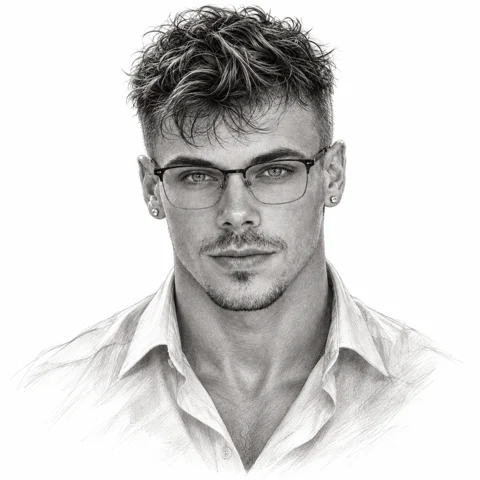
The scrub top lay smooth across broad shoulders and a muscular chest. He put on his dark rectangular glasses, framing light, slightly hooded eyes beneath thick brows. His face was lean and angular, pronounced cheekbones above a firm jaw edged with light stubble; the mustache and short goatee were neatly trimmed. He pushed his dark hair off his forehead. The sides were shaved close, but the longer, textured top fell forward again as soon as he took his hand away.
The sharp pain took him two steps before he reached his go-bag.
It came up through the right knee like a hot wire drawn tight, and his hand shot out and caught the dresser’s edge, and for a moment Anton stood in his own bedroom with his weight on his heel and his eyes closed and breathed through it the way he’d been breathing through it since he was small. Hated was too small a word for what he felt about the bleed. He had lived his entire life with a traitor running the plumbing — blood that pooled instead of stopping, that sabotaged him from inside, quietly, at its own chosen hour. The warden. His blood had been the warden of his prison for thirty-two years, and today it had chosen his right knee, and today he had a twelve-hour shift.
He had already given himself the prescribed factor infusion for the bleed. It could stop the bleeding; it could not make the blood already in the joint disappear on command.
He waited. The wire loosened to a throb.
Then he did what he always did with pain: he put it in its place and continued the inspection.
The go-bag hung on its hook by the door. He checked it the way a pilot checks a plane he personally built. Stethoscope: designated pocket, correct. Pens: correct pocket, arranged by point size, then color, because a man needed to find the fine black one without looking. ID badge clipped where it belonged, beside the water-bottle sleeve. Spare scrubs and a change of normal clothes in the main compartment, folded to the same depth. The daily newspaper and two books sat neatly against the inner wall, spines aligned. Everything exactly where it belonged, which was the only way anything was allowed to be.
He carried a bottle of water in from the kitchen and seated it in the sleeve.
Still annoyed — the throb in his knee pulsing along with his pulse like a metronome he hadn’t asked for — he laced his shoes and let his mind drift where it always drifted on the bad-knee days, back down the years to a childhood conducted largely in a chair by a window. Bleeds that kept him in bed for days. Weeks, once. Through the glass he could watch the neighborhood boys do all the things his mother’s list forbade: sports, tree climbing, roller skates clattering down the sidewalk like the world’s most carefree cavalry. Ordinary childhoods. His had been a chair, and books, and his mother’s voice.
His mother. God loved her, and God had armed her with warnings. Every goodbye came wrapped in a litany — be careful, don’t run, think about what happens if you fall, think about what happens to me if you fall. Fear had worn her love like a uniform, and Anton, being a child, had resented the uniform without seeing underneath it. He’d spent two decades understanding her and a decade more admitting how long that had taken.
His phone alarm chimed from the counter. 5:00 PM. Time to go.
He silenced it and glanced at the traffic map out of habit — jammed, red spine down the freeway, exactly as the freeway was on every Friday at five, which was why his commute already accounted for it, because the world being predictable was not a gift you refused.
The stairs were the part he dreaded. Second floor to the ground, one step at a time, right leg negotiating every drop like a diplomat in a hostile country. He took them. He noticed, somewhere around the landing, that he was taking them well.
Outside, the evening was Houston in October: warm, damp, unimpressed. He circled his car once. Then, because the first pass had found nothing and that in itself felt incomplete, he circled it again — dents, scratches, door dings from the neighboring space. On the second pass he found a small scuff on the rear quarter panel, faint, and wiped it with a tissue from his pocket until it surrendered. Gone. Satisfied, he moved around to the driver’s side.
And it was as he did so that he realized his knee didn’t hurt.
Not hurt less. Didn’t hurt. He stood still in the parking area and tested it — weight forward, weight back, the little half-crouch that had been extortion all afternoon — and the joint answered like a joint that had never met a bleed in its life. The Vicodin, he thought. Except he knew the limits of his own medication, and this was more than pain relief. And even the medication sat on top of a bleed; nothing dissolved the underlying cause in forty minutes. A bleed like today’s didn’t get reabsorbed. That wasn’t an opinion. That was his own body’s entire published history.
Then he smelled blood.
Faint, but unmistakable — copper and metal, the scent he knew better than anyone alive should know it. He stopped. Turned. The parking area held two cars, a hedge, a dumpster enclosure, nothing. He took a step toward the hedge. Nothing. He stood in the evening air and sniffed like a man who already felt ridiculous, and found only cut grass and hot asphalt.
The smell was gone.
He dismissed it. Exhaustion, the Vicodin, a nose still haunted by work — he ran the list quickly, the way he ran all lists, and got in the car. Whatever was happening in his knee was a gift, and he wasn’t going to look a gift knee in the mouth before a twelve-hour shift that was going to be absolute hell if the pain had stuck around. It hadn’t. He checked his mirrors — left, right, rear, again — started the car, and pulled out toward the Medical Center.
The parking garage received him at a quarter to six, and Anton did not simply get out of his car.
He got out, then walked its perimeter once — checking the distance to the neighboring lines, the angle of his front tires, the position of the vehicle in the space — and noted its position to himself the way he noted everything, a small map filed for later. The camera on the light pole at the row’s end covered this side; the ramp camera caught the other. If anything happened to the car, he knew exactly which footage held the answer. People called it paranoia. It was actually just homework done in advance.
At every parking-lot intersection he checked both directions for traffic, even the one-way, even the empty one.
He was fifteen minutes early, which was the point — fifteen minutes of quiet in his office, lab results on the screen, a shift rehearsed before it happened — when his pager went off.
Anton stopped mid-stride and looked at it with genuine offense. Being paged before handoff was one of the small blasphemies. The ritual of the beginning of his shift existed for reasons: he sat in his office and read every patient like a novel he’d assigned himself — labs, vitals, the day’s events, the whole treatment history — and then he did the thing no one had taught him in any classroom because it was only his: he simulated the shift. Ran the disasters before they ran themselves. If this patient crashed at 2 AM, the algorithm was already in his head, pre-installed. If that one bled, the protocol was loaded, the doses calculated, the blood bank’s phone number warm in his mind. He rehearsed catastrophes the way other men rehearsed golf swings, so that when the real one arrived he would be executing rather than reacting.
He checked the page again, as though a second reading might improve its manners.
A room number. Critical care. And the diagnosis, in the terse telegraphic dialect of paging operators:
Decomp cirrhosis c/b HRS-AKI, refractory shock.
Decompensated cirrhosis, complicated by hepatorenal syndrome–acute kidney injury, now in shock that no longer answered to anything. Anton’s stomach turned over once, neatly, like a page being dog-eared. He knew — had known since residency, had sat at desks learning it before he’d ever stood at a bedside proving it — how cases with that string of words ended. There was a single destination down that road, and it did not have rest stops.
He headed for the service elevator behind the cafeteria, because he’d mapped the building’s arteries years ago and that was the fastest route from the garage, and he was three strides into the corridor when the smell came back.
Strong, this time.
Copper and metal, thick enough to have texture, the scent of blood in volumes — and there was no blood. The service corridor was clean, buffed, smelling of floor wax and the cafeteria’s rice. Anton slowed without deciding to, nostrils flaring, head turning toward the kitchen doors, the trash room, the loading area. Nothing. There was no source, and the smell did not care, and it sat in his throat like a coin.
There’s blood in the air, said some part of his mind, uselessly, unnecessarily, a part that had apparently decided to be no help at all tonight.
He walked faster. He was scared — quietly, competently scared — that the knee would flare on him mid-corridor and drop him in front of the cafeteria, and his leg was a liar of a different kind entirely because it felt wonderful. Better than it had any right to feel, better than factor or the pain pill could explain, a joint behaving like the bleed had already healed. The pain pill could not repair the joint. The factor could not clear the blood already pooled inside it this quickly. Medically, the speed of it was not a thing that happened.
He pushed it back with the rest. The knee was an anomaly, and anomalies could wait in a queue like everyone else, because somewhere above him a cirrhotic liver was failing in a man who needed a hematologist — because of the coagulopathy, that was why they’d called hematology — and whatever Anton’s body was doing tonight, his job was the patient’s blood, not his own.
He rehearsed the approach as he walked. Failing liver, failing kidneys, shock. Coagulopathy in decompensated cirrhosis, concern for a consumptive process — he’d need the fibrinogen, the platelets, the INR, the whole bleeding profile. He had the algorithm half-built in his head by the time the elevator doors opened on the critical-care floor.
The room was a fight when Anton walked in.
The patient lay in the center of it, deeply jaundiced — a yellow that had gone green at the edges, the color of a body that had stopped pretending — and mottled, the map of his circulation drawn in blues and grays across his chest and limbs. Minimally responsive. Ventilating in shallow, inadequate sips. The monitor above him ran the numbers of profound circulatory collapse, the pressures so low they read like typos.
Anton read the room the way he read everything, in order, without hurry that would show: respiratory therapy at the head of the bed with the intubation kit open and prepared to take the airway emergently; two nurses juggling vasopressor lines and IV access, one of them drawing repeated labs off the line, the other pushing resuscitative medications with the focused calm of people doing eleven things at once correctly.
He took the chart and read the labs, and the labs read like an obituary. The picture assembled itself in his head with the horrible neatness of a case he’d rehearsed: catastrophic multiorgan failure, the liver gone, the kidneys following, the circulation in its final negotiation. Based on the physiology — the actual, working physiology, the kind he could derive on a napkin — this man’s heart was going to arrest. Soon. Anton gave him fifteen minutes without dramatic improvement, and he would have been generous, and he did not believe in generosity with numbers like these.
Then a physician Anton half-recognized came in and told the team, quietly, that the family had elected comfort measures only. No further invasive intervention. No life-prolongation. The family wanted him allowed to go.
The room changed key.
Respiratory therapy lifted the intubation kit away and closed it, gliding the laryngoscope home untouched. The vasopressors were discontinued, line by line, the pumps silenced. The escalating labs stopped being drawn. The interventions that had been holding a dike together against the sea were dismantled, piece by piece, according to the new goals of care, and the violence of medicine withdrew and left behind the older, quieter work: the bedside nurse remaining, adjusting the blanket, wetting the patient’s lips, doing for a dying man the things that could no longer help him survive but could still keep him from being alone.
The resuscitation team cleared out in twos and threes.
Anton stayed.
This was not medicine, and he made no claim that it was. He had believed for as long as he had believed anything that nobody should cross the threshold of death alone if there was a person available to stand there with them, and he was available, and so he stayed. He’d held this vigil more times than he could count. He knew its rhythms — the way the room’s sound narrowed, the way the monitor’s numbers wandered down the last hallway — and he settled in near the foot of the bed to wait for a death he had already, professionally, scheduled.
Fifteen minutes passed.
The patient did not die.
Anton looked at the monitor with the first genuine flicker of surprise. Without the pressors, without support, on a heart this sick, in a body this far gone, the physiology on display should not have sustained anything. And yet: the heart kept producing its inadequate rhythm — weak, ugly, but there. Occasional agonal respiratory efforts still lifted the man’s chest, shallow and terrible, but rhythmic. There was still some circulation detectable in his extremities. Dying, unmistakably. But stalled at the door of it, like a man who had forgotten the way through.
Delayed, Anton told himself. Arrest merely delayed. The body was a machine running down; machines took varying times to stop. He had seen enough deaths to know they didn’t always follow the schedule.
More time passed. The monitor did not agree to finish.
The patient hung in the same catastrophic condition — no better, no worse, the same inadequate rhythm, the same agonal breaths, the same mottled periphery — suspended, held, pending. Anton began checking the monitor more frequently than a hematologist at a comfort-care vigil had any statistical need to. He stood at the foot of the bed with his arms folded and watched a dying man decline to die, and something at the base of his skull, some instrument he owned but had never used, registered a reading he had no drawer to file.
By forty-five minutes he could no longer stay without wrecking the rest of his shift. He was already behind schedule — fifteen minutes of it burned before he’d ever reached the floor — and he knew from long experience exactly how many hours it would take to catch up.
Before he left, he stopped at the nurse’s station beside the room.
“Page me when he expires,” Anton said. “Whatever time. I want to know.”
The nurse nodded, and Anton walked away down the corridor, deeply unsettled, absolutely certain that the page was coming shortly.
The shift absorbed him the way shifts did — consults, rounds, patients scattered through the building’s floors like stations of a very long cross — and through all of it, like a song stuck behind the music, the first patient stayed.
It bothered him with a persistence that was itself diagnostic. Anton understood the diagnosis; he could have taught it — the organ failure, each step of it, cause to effect to cause, precisely why the man was dying. That was the whole problem, the thing that kept snagging his attention like a sleeve on a doorknob: he could explain every reason the patient should be dead, and not one reason — not medication effect, not lab error, not monitor artifact, not some exotic physiologic variant — why the dying hadn’t finished.
What is keeping this patient alive?
Whenever his rounds brought him back to the ICU, he stopped at the same desk and asked the same nurses the same question, and got the same answer, dressed in whatever the hour’s mood was: still there. Still critically ill. Still barely maintaining circulation. Still not dying.
By the middle of the night, Anton had stopped being surprised and started being unsettled, which was worse. Unsettled didn’t resolve with a page or a lab value. Unsettled only grew.
At 00:23, his pager went off again.
STAT Hematology — ICU 3C-08 — APL c/b DIC, massive hemorrhage.
Anton read the page twice and felt the same empty place open in his stomach, that specific gravity that arrived on the shifts where people were going to die. Shifts like this happened. That was the job; you didn’t get to ration them out. He hated them anyway, hated them with a fresh hatred every time, and he was already walking.
The ICU room was packed. Anton paused one stride inside the door, cataloguing: critical care managing shock and respiratory failure and the overall resuscitation; a fellow hematologist — Bassey, from the daytime service, evidently held over — already directing the APL and coagulopathy treatment; critical-care nurses running blood products through one line, vasopressors through another, pushing medications, drawing serial labs; respiratory therapy at the ventilator, suctioning blood from the airway again and again, the circuit cloudy with it; a fourth nurse on the phone with the blood bank, coordinating the next coolers of product like an air traffic controller in a war.
And the blood. The blood was everywhere, and Anton looked at it, and for one fleeting, unbidden instant, the instinct arrived — quiet, wordless, certain in the way things are certain before language gets involved — that the patient was already beyond saving. That the blood spread through this room had no vitality left in it at all. That he was looking at something already over.
The thought lasted less than a heartbeat before Anton rejected it. You’re exhausted, he told himself, filing it under artifact, under imagination, under the strange untrustworthy instrument that had been giving him readings all night. He was not used to the sense, did not trust it, and had no intention of starting in a room like this one. He put it away and joined Bassey at the bedside.
“Talk to me.”
“APL, suspected at presentation. ATRA started the moment it was suspected — no missed doses.” Bassey delivered the briefing in the clipped trade language of two people who shared a dictionary. Anton confirmed when the first ATRA dose had been given and checked the dosing schedule, then pulled the labs and read the catastrophe: platelets down near the floor of the instrument’s range. Fibrinogen nearly absent. Hemoglobin in the basement. Coagulation studies prolonged past the point where the numbers described a person who should be clotting at all. Ongoing consumption and runaway fibrinolysis — clotting factors and platelets used up, newly formed clots broken down, faster than replacement could catch up.
And the blood kept arriving to prove it. It filled the suction tubing in long red braids. It accumulated in the ventilator circuit with each pass of the catheter. Bloody gauze was stacked around the central-line dressings; the access sites oozed steadily, as though the skin had forgotten its one job; blood remained around the patient’s mouth no matter how often it was suctioned; purpura and bruising bloomed across the skin like weather. Subconjunctival hemorrhages spread across the whites of the patient’s eyes, red crowding the clear edges of the corneas.
Anton worked. The work was the same whether the battle was winnable or not — that was the discipline, the whole discipline. Aggressive replacement had to continue; he said so, and it was already being done. Additional cryoprecipitate and fibrinogen replacement — confirmed, ordered. Continued platelet transfusion and fresh-frozen plasma — confirmed. Packed red cells kept coming because the hemorrhage was outpacing the replacement, and they all watched the hemoglobin lose its race against the blood loss. The electrolyte abnormalities and the transfusion-related metabolic derangements were flagged and treated as they surfaced. Serial CBCs and coagulation studies kept cycling, each set worse in the way they’d all stopped remarking on.
Anton understood the shape of it before he left the room: they were replacing components almost as fast as the body consumed them. Almost. The patient was a vessel with a hole in the bottom, and they were pouring, and the hole was winning at a rate that had a number attached.
He would arrest soon, Anton thought. And die soon after that, because this — APL with DIC and a hemorrhage of this volume — was a losing battle that everyone in the room was professionally committed to losing slowly, in the hope of a miracle no one had ordered from the blood bank.
Once the hematology plan was set and running, there was nothing more his specialty could add, and he had a ward elsewhere that needed him. He left.
The metallic smell of blood stayed in his nose long after he’d left the room. Long after he’d left the unit. He noticed it in the elevator, in the corridor, in the stairwell, a ghost of 3C-08 that would not be rinsed out.
And he noticed — again, with the quieter part of his mind that had been keeping a list all night — that his right knee still did not hurt. Gratitude first, because the shift would have been unendurable otherwise. And then the doubt underneath the gratitude, which would not stay closed: the recovery was too fast. Medically, embarrassingly, plainly too fast. He had bled into that joint yesterday. Bleeds like it had cost him weeks.
In the elevator’s aluminum doors, his own reflection watched him with hooded eyes, and Anton let himself do the thing he had been refusing to do since the parking lot. He laid the anomalies side by side on the desk of his mind.
One patient in terminal collapse, alive hours past plausible — the chart upstairs proving it with every hour that passed. A second patient now, hemorrhaging out from under the best replacement therapy in the building, and every instinct he had — including the strange new one — saying this one would be just as slow to finish. And his own knee, healed on a schedule no medication or physiology could sign off on.
Three unexplained variables in one shift.
He did not conclude that physiology had stopped working. Anton Lacasse was not a man who leapt; he was a man who checked the ground. What frightened him was smaller and colder: the facts were still facts. Every one of them. He could verify each data point individually and had.
They simply no longer added up.
His office received him at some hour the night had stopped naming, and Anton sat down at his desk and, instead of doing the sane thing — going gently into the two hours of margin his schedule allowed, letting the critical cases belong to the ICU — he pulled up both charts side by side.
He compared them the way he compared everything: systematically, exhaustively, with the door shut. Laboratory trends, laid over one another. Vital-sign records, hour by hour. Interventions, timelines, the whole documented arc of each admission. He looked, specifically, at duration: how long each patient had now remained in terminal physiological collapse, measured against what the textbooks — his textbooks, the ones he was now, God help him, an authority on — said that state could last.
He searched for a shared medical explanation with the diligence of a man who wanted, more than he wanted most things, to find one.
The diagnoses were different — cirrhosis here, leukemia there — different diseases, different mechanisms, different organ systems failing by different routes. The treatments had been different. The patients were different. What they shared was one thing only: prolonged survival at the point where Anton expected death, and the shared thing was not a medical fact. It was the absence of one.
And underneath the charts, under everything, his own knee sat like a third patient that would not be filed. A body that had repaired itself on no schedule at all.
He sat looking at the two impossible charts on one screen, and the disturbance in him changed register — from strange shift to pattern — and the register change was the frightening part, because patterns were the thing Anton’s whole mind was built to find, and he had found this one against his will.
Exhaustion took him mid-sentence in his own notes. His head went down onto his folded arms beside the keyboard, and the last thing he saw was the cirrhosis patient’s heart rate, inadequate, stubborn, alive.
He fell asleep at his desk.
At 04:42, the pager went off like an intruder.
Anton came up off his folded arms with his heart slamming, disoriented by the overhead lights, a line of keyboard keys printed faintly on his forearm, and read the page through the smear of his own breath on the screen.
STAT Hematology — MICU 3C-12 — fulminant TTP, multiorgan failure.
His mood, already in traction, sank further. On the walk to the MICU he heard himself think it — the thought of a tired man, beneath him, irresistible: full moon? Mercury in retrograde? He did not believe in either. He was starting to believe in this shift. Two catastrophic cases already lingering past every expectation, and now a third emergency, as though the hospital had mislaid the other half of the process.
The MICU room held its own weather. An apheresis nurse stood watch over the therapeutic plasma-exchange machine, its pump breathing with mechanical patience, the patient connected through a large-bore central venous catheter — blood moving out through the circuit, plasma spinning off, donor plasma moving back in, the machine removing antibodies and replacing the missing enzyme, exchange by exchange.
The pretreatment sample for ADAMTS13 activity and inhibitor testing had been drawn before the exchange began. Treatment had not waited for the result: intravenous corticosteroids were already in, caplacizumab had been started for the strongly suspected immune TTP, and rituximab was being coordinated around the plasma-exchange schedule. Anton checked each part of the plan.
“How long has the exchange been running?” Anton asked, and got the answer, and read the chart, and took the bedside handoff, and the numbers were what he already knew they would be: profoundly abnormal, every system of interest failing at once. The physiology on display was not sustainably compatible with life — that was not an impression, it was plain fact. On the ventilator, with the settings already high and the tube position confirmed, oxygenation remained catastrophic. Respiratory therapy worked the machine steadily — adjusting, checking, suctioning, watching pressures — and the patient did not stabilize.
Anton asked for the peripheral smear and hemolysis studies, and then, because some things a man should verify with his own eyes, he went to the laboratory to examine the prepared slide himself.
Schistocytes, in numbers. The red cells lay under the lens in jagged, broken fragments — cells shredded, not merely damaged — and the severity of the microangiopathic hemolysis was unmistakable, textbook-unmistakable, the kind of slide you showed students precisely because no one could miss it. He sat back and let the mechanism assemble itself, because the mechanism was known: platelets consumed in platelet-rich microthrombi seeding the small vessels everywhere; the platelet count collapsing in response; the microvascular obstruction starving organs of perfusion as it spread. The severe renal failure — understood. The ischemic brain — understood. The fragmenting red cells, the disappearing platelets, the injured heart, the shock — each one understood, each one connected to the next by causal tissue he could have drawn on a whiteboard in his sleep.
Nothing about the diagnosis was mysterious.
What was mysterious was that the patient remained alive.
Back in the MICU, Anton stood at the foot of the bed and made himself count it plainly: this was the third critically ill patient, on one shift, to survive beyond where complete physiological failure should have occurred. Three unrelated diseases. Three unrelated mechanisms. One identical, impossible endpoint. The pattern could no longer be dismissed as a bizarre outlier, because outliers came singly, and this was a series.
And they were not recovering — that had to be said exactly, because a man’s mind will offer him false mercies. Their organs were not recovering. Their laboratory values were not normalizing. Their diseases continued, active, unchecked, doing everything disease does.
They simply were not finishing the process of dying.
Anton stood in the MICU with his hands in the pockets of his white coat. For the first time that night, he let himself acknowledge it: he was horrified.
At 05:37, the pager again: STAT — Emergency Department — hemophiliac, severe headache, flank pain.
Anton was moving before the second line finished printing itself in his head, and the fear arrived with the first step, because the hemophilia community was a village wearing a nation’s clothes. Severe headache in a severe hemophiliac was not a symptom; it was a verdict waiting for confirmation — intracranial bleed until proven otherwise, the one outcome that had been read to him like a bedtime story his entire childhood — and his first thought, uncharitable to no one, was please be a stranger.
He saw the age in the triage note. A young man. Barely into his twenties. And thought, with a pity that had nowhere to go: God, at that age, a brain bleed—
The smell reached him in the ER corridor.
It stopped him flat, one stride past the ambulance doors. The coppery metallic scent, stronger than it had been all night — strong enough now to be less a smell than a pressure — and the ER bay in front of him held no visible blood at all. Clean floors, clean walls, staff in unmarked scrubs. He stood in the middle of the busiest department in the hospital with blood in his nose and none in his sight, and made himself walk.
The patient was awake. That was the first mercy, and it let Anton see the face before he saw the chart.
Anton knew him.
Gabe. Gabe Young — hemophilia foundation events, the summer camps, the fund-raiser walks, the compact world where severe hemophiliacs knew one another the way alumni of the same small disaster do. Years ago, Anton had been a camp counselor, and Gabe had been assigned to his cabin — a boy of eleven or twelve with a grin too big for the cabin and a medical alert bracelet he’d learned to flash like a badge instead of hiding it. Anton had counted out factor infusions at a picnic table and taught the kid to whistle with a blade of grass. The memory arrived whole, and with it the case stopped being just a consult. It was Gabe.
“Anton.” Gabe’s voice was rough but present. Awake, oriented, talking — holding onto it. “Man, tell me this is the flu.”
“Hi, Gabe.” Anton’s voice did the thing it did with frightened patients — came down half a register, found its warmth, told the truth. “I’m here. We’re going to find out what’s happening, and we’re treating the bleeding now.” He wanted to say you’re going to be okay. The boy — the young man — needed to hear it, and Anton needed it to be true. But he did not promise what he couldn’t deliver. He stayed where Gabe could see him.
Gabe told him about the headache — severe, sudden, the worst — and the flank pain, and the pain had spread, groin, lower abdomen, the whole left side of his trunk. And Anton’s clinical mind, hanging every symptom on the hook it feared, laid the picture out: a severe hemophiliac, high-titer inhibitor, this symptom cluster — catastrophic internal bleeding until disproven, and possibly more than one site.
He examined him with hands that did not hurry. He ordered emergency bypassing therapy immediately — rFVIIa, recombinant activated factor VII, because Gabe’s high-titer inhibitor made ordinary factor VIII replacement unreliable. He confirmed the first dose had been administered before Gabe went anywhere near a scanner. STAT labs. Urgent imaging — head, and abdomen and pelvis.
He was still at the bedside, one hand resting on Gabe’s shoulder while a nurse hung the first bags, when a second nurse came into the bay with an iPad carried against her hip. She crossed to where Gabe sat on the edge of the gurney — legs over the side, because he’d walked in under his own power and refused to lie back — and dropped her voice into a register Anton knew, the one designed for this exact errand, gentle and administrative at once.
“I have the paperwork you asked for,” she told him. “I just need your signature whenever you’re ready, so we can honor your wishes.”
Anton understood in one beat. He did not need to see the screen. DNR — do not resuscitate. And here was the boy from his cabin, twenty-two years old, reaching for the tablet and stylus as if he were signing in for a camp activity.
Anton’s concern arrived before he could weigh it — and it was not the physician’s concern, not entirely. It was the counselor’s. He had known this child at eleven, grinning around a mouthful of braces, flashing his medical alert bracelet like a badge. That boy, signing this document. He’s not choosing well, Anton thought, and could not tell how much of the thought was medicine and how much was memory.
“Gabe.” Quiet. He waited until the young man’s eyes came up off the screen. “Are you sure you want to sign that?”
Gabe glanced at the tablet, then at him, and shrugged — casual, almost airy, a shrug built for throwing off the whole subject of dying. “Please just tell me it’s the flu.”
The same plea he’d greeted him with. This time Anton couldn’t find an answer. He went silent.
He felt the boy’s eyes on him. He looked up from the floor he’d been studying and the look was uncomfortable to hold — level, patient, older than twenty-two — so of course he held it.
“I know what it’s like,” Gabe said. “I’ve lived my whole life like this. In fear of it. Waiting on the next bleed, the next ER, the next time somebody’s rushing me somewhere with the lights on.” He turned the stylus over in his fingers. “I don’t want to go through unnecessary pain or suffering. I’ve thought about this longer than you think.”
Anton opened his mouth to make the case — nothing was confirmed yet, the imaging hadn’t happened, there were still things they could do — and Gabe cut him off, gently, the way you’d stop someone from overfilling a cup.
“Anton. It’s my decision.” No anger in it. No performance of bravery either. Just the fact, set down between them like something heavy he’d already finished carrying. “If the end comes, I want it to be mine. I want to be the one who decides — not the code team, not anybody else. I’m not telling them to stop treating me.” He nodded at the line going into his arm, the bags on the pole. “Keep going. All of it. But if my heart stops — I want you to respect that. Please.”
There was nothing in his face to argue with. That was the worst of it. Anton had prepared, in the two seconds it took the nurse to hand over the stylus, an entire clinical rebuttal, and Gabe had dismantled it before Anton spoke a word of it, simply by reminding him whose decision it was.
Anton made himself ask the question plainly. “You still want treatment, including a breathing tube if you need one. But if your heart stops, no CPR. Is that right?”
“That’s right.”
“I will,” Anton said. “I respect it.”
Then, because he was still a physician and still himself, he reached for the other thing: you’re going to be fine. He felt the words line up, felt the shape of them, standard-issue comfort — the paperwork is routine, people sign these and go home —
He stopped himself. He had not survived this long on promises he couldn’t keep, and he was not going to start with this boy.
“The paperwork is standard,” he said instead. He moved to where Gabe could see him without turning his head. “That doesn’t change the treatment you’re getting now. Every dose, every scan, every consult — you have all of it. You have me.”
Gabe signed, the stylus moving steadily across the glass. The nurse took the tablet back. Anton documented the conversation and entered the DNR order, keeping the plan for active treatment in place.
The metallic smell thickened in the bay, stronger than it had been all night. Anton could feel it even with Gabe calm on the edge of the gurney, and there was not one visible drop of blood anywhere near them. It sat in the bay with them like someone who had not been introduced, an ominous pressure arriving ahead of the thing itself.
Only when the treatment was in and the orders moving did he step out of the room.
The blood-smell came with him, painful, sourceless. And with it came the feeling — the untrustworthy instrument again, the one he’d been refusing all night — arriving now with a clarity he couldn’t dismiss by calling it exhaustion: this case is going to deteriorate.
The symptoms already justified his concern; the certainty of what would follow was something else. He put that certainty aside, because he was a scientist before he was a prophet, and walked into the corridor to find the charge desk.
The hospital got there first. Staffing called while he stood at the counter: could he stay on for an additional twelve-hour shift? The building was strained past its seams — traumas coming in, patients lingering past every expected death, and call-outs stacking on call-outs. Anton looked down the corridor, at the ceiling he’d been watching for approximately twelve hours, and said yes, because there had never been a scenario in which he said anything else.
He saw one other patient, relatively stable, and was closing that note when a nurse he knew well came around the corner at a walk that meant the opposite of stability, and said his name, and said Gabe had lost consciousness during the imaging — during it, or immediately after — and had begun to seize. The seizure had been treated; he was responding again, but poorly.
The floor did not disappear. The floor simply stopped being there.
Anton had been raised on this exact catastrophe. Intracranial hemorrhage was the monster under his particular bed, the one his mother’s warnings had been armor against his entire life, the bleed every hemophiliac learns to fear above all bleeds — and now it had a face he’d taught to whistle, and it was happening twenty feet away.
He went to the nurses’ station and commandeered a computer without asking.
He pulled up Gabe’s scans himself, before any finalized radiology report could arrive with its cautious, hedged, clinical-correlation-recommended language, because he did not require language. He opened the head CT.
The hemorrhage announced itself. Acute intracranial blood, a bright and brutal collection with edema crowding in around it, and mass effect — the brain’s midline already leaning away from the bleed like a tree bent by wind. The findings were obvious enough that a medical student could not have missed the danger. Anton read it in four seconds and felt the four seconds cost him a decade.
He opened the abdominal and pelvic imaging.
There it was — the flank pain’s source, large, grotesque, expanding: a retroperitoneal hematoma, blood filling the space behind the abdominal contents, gobbling the anatomy he’d memorized in first-year med school. The iliopsoas, infiltrated. Gabe was bleeding from two major sites at once, his brain and his trunk, both of them, simultaneously, and the world went distant and white at the edges and Anton gripped the counter’s underside with one hand and forced it down — the lightheadedness, the rising black — because Gabe needed a hematologist, not a fainting one, and Anton was the hematologist responsible for him.
Then he worked.
Orders, rapid and sequential, each one attached to the reason that had produced it: repeat CBC and coagulation studies — STAT. Type and crossmatch, units to match the hemorrhage he could see, plus more. Updated factor level and inhibitor titer as the labs returned. The central problem remained the inhibitor: Gabe’s own immune system neutralized factor VIII before it could work. The first dose of rFVIIa was already in; Anton confirmed the repeat dosing schedule and continued the bypassing therapy. Aggressive red-cell replacement and supportive treatment began in the same breath.
Neurosurgery: consulted, urgently, paged with the word intracranial doing the work of a paragraph. Interventional radiology: consulted on the retroperitoneal hemorrhage, images pushed to their read room while he was still standing at the computer.
And through all of it — while Gabe, an ER patient who had walked in complaining of a headache, was transformed around him into a full resuscitation, lines and monitors and blood going in and no one, no one, saying the thing everyone was thinking — the metallic smell of blood grew stronger.
It followed Anton from the computer to the bedside and back. It thickened as Gabe deteriorated, as if it were barometric — as if it were measuring something — and there was still, in all the world, no physical source anywhere near enough to explain it.
And for the first time, in the corridor of that ER, Anton Lacasse allowed the thought all the way up, gave it one full second of his attention before he put it away again:
What if this isn’t the smell of blood at all?
What if it’s the smell of dying?
Before transfer, Gabe’s neurologic status worsened again — harder to arouse, then not arousable, his responses shrinking from words to grimace to nothing. When he could no longer protect his airway, the emergency team secured it: rapid-sequence intubation, tube placement confirmed, ventilation established. Neurosurgery and critical care were already involved.
They moved Gabe up to ICU-level care inside the hour, with his airway secured and the treatment continuing. The transfer was a relay, each team carrying the baton a few meters before handing it on.
The relay did not slow the race. On the unit, his pupils drifted out of symmetry, one blowing larger than the other, the oldest and worst message a pair of eyes can send: the pressure inside is rising; the brain is being displaced. The team elevated the head of the bed and gave a bolus of hypertonic saline for the pressure crisis, supporting his blood pressure and following his pupils for a response. The swelling did not yield.
Anton carried his laptop into the room and posted himself at the bedside.
It was not medicine. He knew it was not medicine. He had colleagues covering the other consults and a phone that worked anywhere in the building, and he did it anyway, because eleven years ago a boy with a too-big grin had been assigned to his cabin, and someone — everyone, the whole arrangement of the universe — had apparently decided Anton would be given him a second time: once as a counselor, once as a witness. He would not leave Gabe alone in the machine-light for this. He set the laptop on the bedside table and worked his other consults remotely, one eye on the ward, both hands unable to stay off the room.
Gabe’s blood pressure began to fall.
His heart rate rose first — the compensatory sprint of a young heart trying to hold a collapsing circulation together — and his skin paled, cooled, went clammy, the periphery surrendering circulation to the center. Serial CBCs tracked the hemoglobin falling despite transfusion, unit after unit going in and the number going down anyway, because the retroperitoneal bleed kept expanding — the flank and abdomen visibly distending, centimeter by centimeter, hour by hour — and the hemorrhagic shock deepened with each CBC. The intracranial hemorrhage expanded too, on its own schedule; repeat imaging showed edema spreading and the midline shift worsening, the brain leaning further and further from its mooring.
Anton and the ICU team kept Gabe on bypassing therapy — rFVIIa, redosed on schedule, the bypass running at full protocol. Packed red cells went in aggressively, bag after bag, the transfusionist’s workflow as constant as a tide. They were, in the plainest clinical terms, trying to replace blood that was disappearing into two sealed spaces — the skull and the retroperitoneum — faster than the hospital could put it back. Anton watched for the turn, the transfusion response, the first lab that showed hemostasis catching. There was none. There was no evidence of sustained hemostasis at either bleeding site.
Neurosurgery called at mid-morning.
Anton stood in the corridor outside Gabe’s room with the phone to his ear and listened to colleagues say carefully what he had already said to himself in the night: they had fully reviewed the head imaging. They had considered decompression — a craniotomy, an evacuation of the hematoma, an operation that might have offered a way to relieve the pressure if the bleeding could be controlled. It was not the answer here, and they walked him through why, in the language of their craft: Gabe could not reliably clot.
Severe hemophilia A meant his effective factor VIII activity was essentially absent; the high-titer inhibitor made conventional replacement unreliable; the rFVIIa was buying partial, provisional, unsustained hemostasis at best. Opening the skull under those conditions invited hemorrhage no scalpel and no suture could then contain — and even if they reached the hematoma and evacuated it cleanly, they might be unable to stop the bleeding afterward. Surgery, in Gabe’s present state, was more likely to accelerate exsanguination than to save him.
They were declining to intervene. Uncontrolled coagulopathy, active hemorrhage, hemodynamic instability, worsening neurologic injury: in their judgment, the operation was more likely to hasten his death than prevent it.
Anton understood the decision. He could have made the same one; on a clear page, in a quiet office, he had made the same one, for other patients, with a clear conscience. Understanding it did not mute what it meant, and he stood in the corridor while the meaning finished arriving: without decompression, the intracranial pressure would keep rising. The injury would run its course unopposed. There was no surgeon coming. There was no cavalry.
Interventional radiology gave the other half of the verdict that afternoon. They had evaluated the retroperitoneal hemorrhage for embolization — some vessel, some target, some procedural rescue — and found none that was real: Gabe was too unstable for transport, too unstable for the procedure, and no realistically controllable bleeding point existed to justify the attempt. No viable target, the note said, in the language of people who had looked for one hard.
No cavalry from any direction. Anton stood in the corridor and absorbed the shape of the day, which was a circle closing: every specialty in the building consulted, every avenue examined, and the sum of all their expertise was wait, and support, and stay.
Gabe’s blood pressure kept falling despite the transfusions and the vasopressors climbing toward their maximum doses. Blood products ran through a warmer; active warming continued, and the team monitored ionized calcium and replaced it as needed. His temperature began to fall despite those measures — the massive hemorrhage and the shock pulling his core down degree by degree — and the cold did its own damage, because hypothermia and acidosis poisoned coagulation further, and worse coagulation meant more bleeding, and more bleeding meant deeper shock. Anton knew the spiral by its first name; every provider in the room did. Bleed, shock, cold, acid, worse clotting, worse bleed. The patient at the bottom of a funnel that narrowed to a point.
The monitor told the story of the afternoon in one line: Gabe’s cardiac rhythm slid from the compensatory tachycardia down through falling rates, the young heart’s sprint becoming a jog, the jog a walk — toward bradycardia, the terminal downshift of a circulation reaching its end. His pupils worsened. Fixed, the anesthesiologist noted. Wider.
And Anton — this was the thing he would carry, the thing the encrypted drive would exist to prove — Anton understood that no one was failing. That was the horror refined to its essence. Everybody knew exactly what was happening. Every intervention that could be justified was running; every consultation had been made and remade; the teams had done, in order and on time, everything medicine knew to do. They simply could not make Gabe clot fast enough to stop it. Medicine had not been caught napping. Medicine was standing at the bedside, fully awake, holding everything it had.
Gabe reached a physiological state in which Anton expected cardiac arrest within minutes, and he caught himself timing it, the way he had timed the first patient, about a day and a lifetime ago. Minutes. Four, perhaps five.
They passed.
The minutes passed, and Gabe’s blood pressure became barely measurable — a tracing with more belief in it than numbers — and his rhythm slowed to occasional escape complexes, lone beats arriving out of the failing muscle like late visitors, and the perfusion through his body became nearly nothing, and the monitor went on displaying the little complex, the pause, the little complex, the pause.
Yet a pulse remained. Anton could feel it at the boy’s — the young man’s — wrist, faint as a memory.
He stood at the bedside and watched the monitor and waited for the final complex. It did not come. Another ordinary, impossible complex arrived instead. Then another. The minutes stacked into a half hour, the half hour into an hour, and the case — which had been, all day, the most tragic thing Anton had ever stood beside — tipped over into the thing he no longer had a word for, and the word impossible would have to carry it.
Gabe was not recovering. Nothing about him was recovering. He was dying — every system still dying, the hemorrhage still hemorrhaging, the brain still swelling — and the dying would not finish. The same suspended threshold. The same door ajar. The same held breath Anton had been hearing in one form or another since his shift began.
The case stopped being tragic and became impossible, and Anton stayed.
By late afternoon, the ICU team had confirmed Gabe’s DNR order from the conversation in the ER. His own decision, made while he could still speak for himself. Treatment continued — the transfusions, the bypassing therapy, the support already keeping him there — but there would be no chest compressions if his heart stopped. Anton had told him he would respect it.
He spent the remainder of the day at that bedside. The laptop stayed open on the table; other consults came to him by phone and he managed them remotely, his voice level, his orders precise, his eyes never longer than a few minutes off the monitor. Staff came and went around him in the rhythms of a unit holding its breath. Gabe did not improve. The catastrophic hemorrhage, the neurologic injury, the shock, the organ failure — all of it continued, unhealed, unfinished.
Anton expected the heart to stop. He had expected it for hours. It never did.
The vigil wore him down the way long vigils do — not in one blow but bit by bit. Physically, he ran down to an exhausted wire; emotionally, something in him sat down under a weight it recognized from childhood, because this — the uncontrolled catastrophic bleed, the blood that would not obey — was the fear his entire life had been built around, and it was not happening to him. It was happening to Gabe, at Gabe’s own bedside, and knowing the boy — knowing the grin, the whistle, the camp-field factor infusions — made the weight specific, made it his. He remembered being responsible for Gabe as a child at hemophilia camp: counting doses at the picnic table, the boy’s arm in his lap, trusting him.
He had been entrusted with Gabe twice now.
And this second time, his whole duty was to remain — to be the person at the bedside during what should have been the final hours, so that the boy would not, in the one way Anton had sworn a person never should, cross the threshold alone.
He looked at his watch. His extended shift had a little over an hour remaining on it — twelve more hours stapled to the first twelve, the whole strange day folded into one continuous watch — and he was already certain he would stay past its end, if it came to that.
He could not have walked away before Gabe died if the building had been on fire.
At exactly 17:00, two things happened in the same instant, and Anton would never afterward be able to untangle which had arrived first.
The first was Gabe’s monitors changing.
The second was his right knee.
The pain that erupted through it was total — blinding, unbearable, the breakthrough bleed and every hour of walking and standing and pushing through the world’s longest shift arriving in the joint all at once, as if a whole day’s damage had struck in a single second. Anton’s vision whited at the edges; his grip found the bed rail and welded to it; and he hung there, upright by force, because Gabe needed him standing and Anton Lacasse could be forced to do anything except leave.
He stayed upright. He looked at the monitor through the pain.
And virtually in the same moment, the hospital began to erupt around them.
Alarms, then announcements — Code Blue. Code Blue, fourth floor. Code Blue, 3C-08. Code Blue, MICU — the intercom stacking the calls one upon another, faster and more numerous than any code rhythm Anton had heard in all his years in medicine, and his mind, even folded nearly in two by the knee, even with the room narrowing to the boy in front of him, caught the numbers. 3C-08 — the APL patient, hemorrhaging since midnight. The MICU — the TTP, suspended at the threshold since dawn. Room after room after room.
His pager began going off as well — buzz after buzz after buzz, one number, another, a cascade of his own name being called from every direction the hospital had.
He could not respond to any of it.
Gabe’s heart was stopping. There would be no code in this room.
Anton’s attention collapsed onto the young man in front of him with the totality of a door closing, and the world — the pages, the codes, the building in its strange convulsion — went away. The rhythm that had impossibly persisted for hours on end finally, finally failed. The barely measurable circulation guttered, and failed. The monitor’s line — after a day of refusing, after a day of a whole hospital’s worth of refusal — went and did what physiology had said all along it must.
Gabe died within one minute.
Anton barely registered the pages, or the Code Blue announcements stacking outside the door, or the nurse who came in behind him and stopped, because inside the room there was only the bed, and the stillness on it, and the silence where a heartbeat had been.
Gabe was gone.
And around him, floor by floor, the other patients who had been lingering at the edge of death — the ones who could not finish, all day and all night and all day — were apparently finishing too.
Anton made his way back toward his office on a leg that had stopped being a metaphor and become a fact, limping on the aggravated knee, each corridor a negotiation.
The hospital was chaos — staff running between rooms, code teams doubling back on their own shadows, the particular shrieking order of a building where many people are dying at once — and Anton moved through it barely registering any of it. Grief, exhaustion, and disbelief had emptied him down to the walking. The last twenty-four hours kept reassembling behind his eyes in the same order no matter how many times he took it apart: the patients who remained alive far beyond anything their conditions should have permitted. Not one of them meaningfully recovered. Every disease and injury progressing on schedule, exactly as the textbooks promised. And the final process of death — the one process he had watched complete correctly a thousand times, the one process medicine could always, always count on — simply unable to complete.
Then, at 17:00, the impossible delay had ended. Everywhere at once. To the minute.
He handed the outstanding pages and the remaining consults to the covering hematologist before he reached his office and closed the door. The small, familiar room received him — the desk, the books, the lamp — and for the first time since Gabe began to deteriorate, nobody was immediately asking anything of him.
Anton Lacasse sat down at his desk and wept.
He wept for Gabe, and for the boy at the picnic table, and for the two entrusted keepings of him, the second of which he had failed in the only way that had ever frightened him: by staying, by doing everything, by being present — and losing anyway. He wept the way controlled men weep, alone, briefly, with the door shut. Then he ran out of tears, or the hour ran out for him, and he forced himself upright and back to the keyboard. Because there was a thing he could still do for Gabe. It would not help Gabe. He did it anyway.
He logged into the hospital computer and took an encrypted flash drive from his desk — the small dark one he kept for exactly this kind of contingency, though he had never once imagined this contingency — and inserted it into the USB port.
He still could not explain what had occurred. He wanted that stated plainly, even to himself: no theory. What he knew was that what he had witnessed was not normal, and that the not-normal had structure. His own rapid recovery had been the first unexplained variable — and its relief had ended as abruptly as everything else, at 17:00, when the bleed had come back to his knee like a flood, all at once, on the same stroke of the clock that took the others. Then there were the patients — bodies standing at the absolute edge of physiological collapse, hours past every defensible limit, not healing, not dying. And finally the end: several of them dying almost simultaneously, on a single stroke of the clock, in a hospital full of them.
His memory was not enough. Memory was the first thing grief distorted, and the first thing a mortality review subpoenaed. If he was ever going to understand what had happened — understand being the word he could still bear, the word that made it a problem instead of a haunting — he needed the original data.
He began assembling the records of the anomalous cases, and the assembly had its own gravity, its own order, and the order steadied him the way order had steadied him since he was a boy in a chair by a window. He copied laboratory results, with timestamps. Vital-sign trends and monitoring data. The relevant physician and nursing documentation. Imaging — all of it, including Gabe’s head CT, the hemorrhage and its edema and the midline shift, and the retroperitoneal collection, the two wounds that had taken the boy from him. Medication records, transfusion logs, interventions, treatment timelines.
He paid particular attention to the intervals that mattered: the periods during which each patient had remained alive despite catastrophic physiology — measured, timestamped, past every limit. And he preserved, with a completeness that bordered on devotion, everything that showed what happened at approximately 17:00.
He began constructing a timeline, case against case, so the comparison could be made directly — onset to onset, threshold to threshold, minute to minute.
He had no theory capable of explaining what occurred. He was not yet thinking in terms of anything larger than a hospital — certainly not in terms of anything global, and not yet in terms of anything that didn’t appear in a textbook at all. He was doing the only thing he had ever done, all his life, when something frightened him and would not be controlled:
He gathered information. He created order. He documented everything.
The flash drive copied, the timeline drafted, the files saved in their folders like patients seen and settled, Anton sat back in his chair in the lamplit office with the hospital’s chaos still dimly audible through the wall.
And it was there, in the quiet he had finally earned, that he noticed it — the absence arriving as its own small, cold shock, the last anomaly of the shift, filing itself politely at the end of the list:
The scent had followed him through the service corridor, the packed ICU, the ER bay, Gabe’s bedside — the whole long haunted day and night of it. Now it was gone.
Anton could no longer smell the blood.